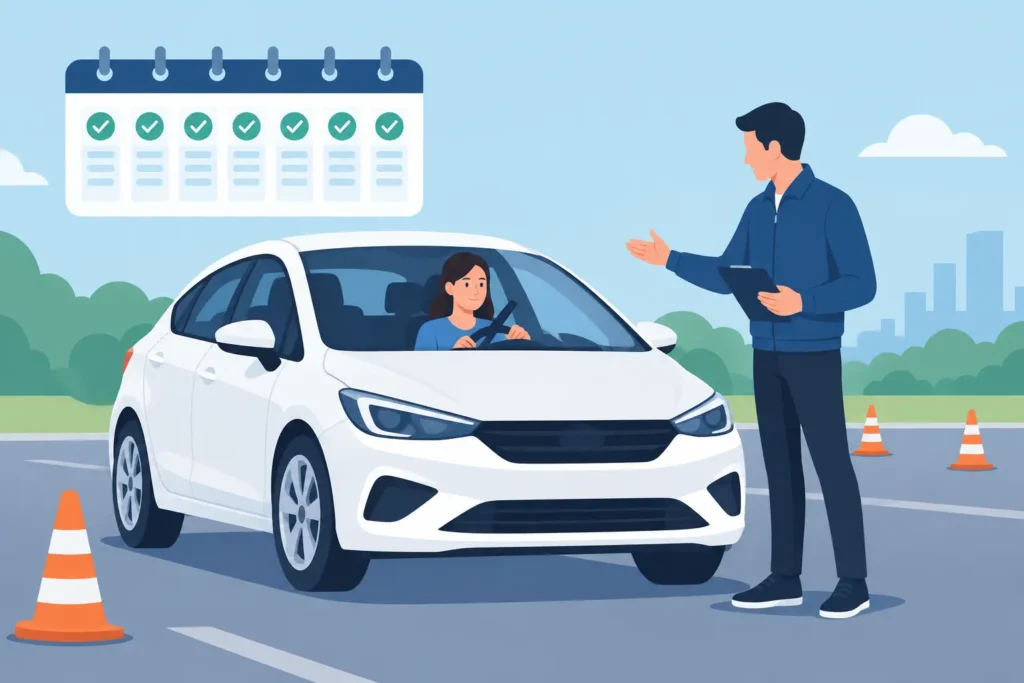
A one-week course is not about rushing through the parts of driving that matter. It is about replacing months of stop-start lessons with a planned block of focused practice. Automatic one week driving courses can suit learners who need to progress quickly, but only when the course length matches their current ability and the time available is used well.
For someone balancing work, university, childcare or a move, a structured week of tuition can make learning feel far more manageable. You spend less time trying to remember what happened in last week’s lesson and more time building on it while the skills are fresh. The aim is clear: develop safe, independent driving habits and prepare properly for the practical test.
What is an automatic one week driving course?
An automatic intensive course brings your lessons together over five or more closely planned days, rather than spreading them across several months. You learn one-to-one with a DVSA-approved instructor in an automatic car, usually with collection from home, work or another agreed local point.
The exact number of hours matters. A learner who can already move off safely, steer accurately, use mirrors and deal with straightforward junctions may be well suited to a 30-hour, five-day course. That is often enough time to improve judgement, practise manoeuvres, handle busier roads and complete mock-test preparation.
A complete beginner will usually need more than a single week. Learning to control a car is simpler without a clutch and gears, but safe driving still depends on observation, planning, positioning, speed control and decision-making. Starting with too few hours can create unnecessary pressure and may leave you less prepared than you need to be.
Why learners choose an automatic course
Automatic lessons remove clutch control and gear selection from the early learning process. For many learners, that means more mental space to read the road, anticipate hazards and make decisions at roundabouts and junctions. It can be particularly helpful if you have found manual lessons overwhelming, are returning after a long break, or simply want to focus on driving in congested traffic.
There is a practical trade-off. Passing in an automatic vehicle gives you an automatic-only licence. You can drive automatic cars, including many electric vehicles, but not a manual car unless you later pass a manual driving test. For some people, this is no disadvantage at all. For others, particularly those who expect to use a family or work vehicle that is manual, it is worth considering before booking.
An automatic course is also not automatically easier in every respect. The examiner still expects the same standard of safe driving. You will need to show effective observations, appropriate speed, good road position, controlled manoeuvres and the ability to drive independently. The transmission changes, but the responsibility does not.
Is one week enough to learn to drive automatically?
It depends on where you are starting from. An intensive course works best when its hours are realistic for your experience, not when it is chosen because a test date is approaching. A learner who has had 15 to 20 good-quality hours previously may need a focused block to bring everything together. Someone with no experience may need a longer programme, sometimes split across more than one week.
Before a course is recommended, think honestly about the skills you already have. Can you move away and stop under control? Do you use mirrors before changing speed or direction? Can you approach junctions with a safe routine, or are you still concentrating mainly on the pedals and steering? Clear answers at this stage help prevent booking a course that is too short.
A good assessment is not about judging you. It is about giving you enough training time to learn properly. That is why an organised provider should ask about your previous lessons, any past test attempts, confidence on different roads and theory-test status before confirming the right package.
What your training week should look like
Each instructor will adapt the plan to the learner and local roads, but a genuine intensive course should have a clear progression. The first sessions establish a safe baseline and identify the areas needing most attention. From there, lessons become more demanding as your consistency improves.
Early work may cover moving off and stopping, meeting traffic, emerging at junctions, using mirrors and developing a dependable routine. As your control becomes more settled, the course can move on to roundabouts, dual carriageways where appropriate, country roads, manoeuvres and independent driving using a sat nav or traffic signs.
The most valuable part of a one-week course is repetition with feedback. If a busy roundabout caused difficulty in the morning, you can revisit the same type of situation later that day or the next day, while the instructor’s advice is still clear in your mind. This creates momentum, but it also requires concentration. Intensive learning can be tiring, so sensible breaks and realistic daily lesson lengths matter.
Towards the end of the course, mock-test practice helps identify whether you are consistently ready. A mock test is not a promise that you will pass the real one. It is a useful way to practise following directions, managing nerves and seeing which faults need attention before test day.
Theory test and practical test planning
Your practical test cannot be taken until you have passed the theory test. If that is still outstanding, build it into your timetable rather than treating it as an afterthought. Theory support and revision materials can make preparation more organised, especially if hazard perception has been a challenge before.
Practical-test availability is separate from the tuition itself and can vary considerably by area. A course should be planned around realistic test options, not unsupported claims that a particular date can be guaranteed. Your instructor can help you decide whether the available date gives you enough time to train and whether you are likely to be ready.
One Week Driving Course coordinates training with local DVSA-approved instructors and provides guidance through theory preparation, course planning and practical-test arrangements. For courses of 30 hours or more, practical-test-fee protection may also provide added reassurance if the test cannot go ahead for a covered reason. Check the course terms before booking so you understand exactly what is included.
How to get the most from an intensive course
Keep the week as clear as possible. Long shifts, late nights and competing commitments can make it harder to retain what you learn. Arrive ready to concentrate, wear suitable footwear and let your instructor know early if a particular situation makes you anxious.
It also helps to treat feedback as a training tool rather than a setback. Most learners have habits to improve, whether that is checking mirrors too late, approaching too quickly, hesitating at roundabouts or losing focus after a small mistake. Progress comes from recognising the pattern and practising a better response repeatedly.
Between lessons, avoid trying to memorise test routes. Roads, traffic and examiner directions will vary. Instead, review the routines behind safe driving: observations before action, good forward planning, appropriate gaps and calm responses when something unexpected happens.
Choosing the right automatic course length
Course length should be based on ability, not optimism. A short retest package can be appropriate if you recently failed and need to address a small number of faults. A five-day course can work well for learners with basic experience who need structured practice. A longer programme is the more responsible choice for beginners or anyone whose driving is not yet consistent.
Ask what the quoted hours include, whether tuition is one-to-one, how pickup arrangements work and what support is available if your test date changes. You should also be clear about the automatic-only licence before committing. Straight answers at the beginning make the whole process easier to manage.
No driving school can guarantee a pass, because the DVSA examiner makes the final decision on the day. What a well-planned course can offer is something more useful: enough focused practice, honest guidance and a clear route towards test readiness.
If an automatic one-week course fits your experience and timetable, give yourself the best chance by choosing the hours you genuinely need. Calm, consistent driving is built lesson by lesson – and that confidence will serve you long after the test is over.